DO YOU NEED ANOTHER SHOT IN THE ARM?
Elimination of vaccination requirements will result in a drop-off in immunization rates which could result in the resurgence of diseases that have been virtually eliminated in the United States. Children will once again suffer from communicable diseases. Some will die from complications known to be associated with these diseases and the health of exposed children too young to be immunized and immunocompromised adults may suffer. Years of research have found the medical community’s recommended vaccines are safe and effective. They reduce the incidence of illness by an average of 4 illnesses per child, hospitalizations by an average of 1 per three children and prevent an average of 37,633 deaths annually. Allowing children to catch the virus to develop immunity is not safe. Immunizations can only protect the community when the immunization rate among children is high. They are most protective when immunization rates are 90-95%. There are no credible scientific studies that support any connection between vaccines and autism or other developmental disorders.
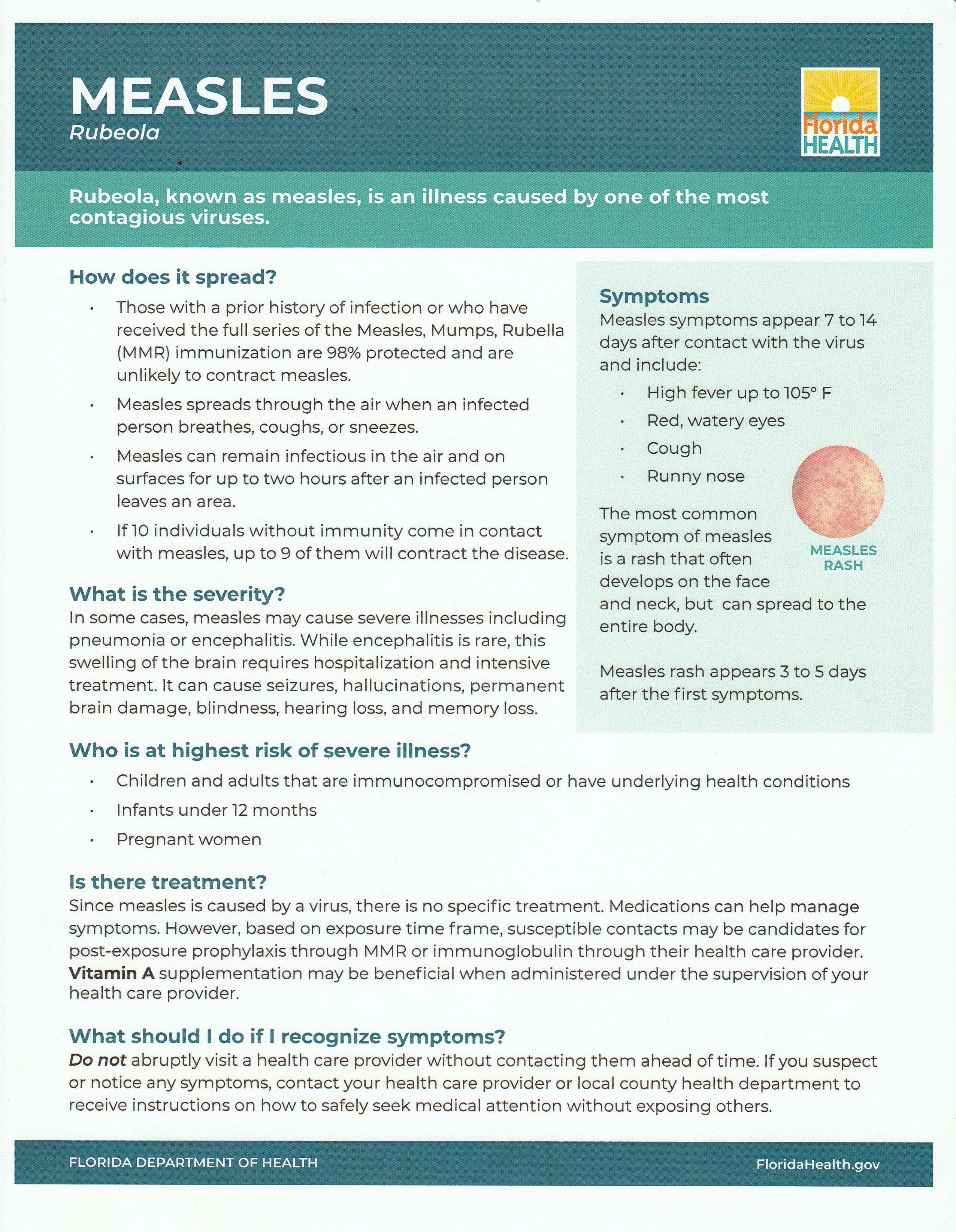
MEASLES
Measles is the most contagious disease known and can be serious, especially for young children. It spreads when a person coughs or sneezes and can linger in the air for up to 2 hours after the person left the room. Measles causes a distinctive rash with flat red spots, along with fever and upper respiratory symptoms. Not only does it cause significant illness and a high likelihood of hospitalization (1 in 5 of those infected), it also often causes immune amnesia, meaning that children are susceptible to infections that they had previously been protected against. More severe complications sometimes develop, such as pneumonia and encephalitis. Before a vaccine was available, measles was responsible for an estimated 2.6 million deaths a year. MMR typically provides lifetime protection against measles. At least 95 percent of the population needs to be immune to achieve herd immunity, which is critical for protecting those who can’t be vaccinated, such as children younger than 12 Months.
Source:https://www.mayoclinic.org/diseases-conditions/measles/symptoms-causes/syc-20374857
PERTUSSIS
After measles, the second-most concerning illness is whooping cough, or pertussis. Whooping cough is not only miserable, but also often incredibly dangerous for young children. The first symptom for infants is often apnea - they just stop breathing, which is why it can be fatal. Others will start with a runny nose and quickly develop the severe coughing fits and gets its name from the “whooping” sound people make when gasping for breath afterward. The pertussis vaccine — the “P” in the DTaP and Tdap shots, which also cover diphtheria and tetanus — protects against whooping cough; the first dose can be given at 2 months. This vaccine does not offer lifelong protection, so boosters are needed, especially during pregnancy, when a mother can pass some immunity to her baby for the first weeks of life, as well as for other adults caring for a newborn.
Source: https://www.marybridge.org/blog/whooping-cough-signs-symptoms/
MENINGITIS A, C, W, Y and B
Meningococcal disease is fast-moving and serious, potentially causing death within hours. It generally starts with similar symptoms to the flu, but quickly progresses to a severe headache, neck stiffness, and a rash that looks like purple bruises on the legs due to problems with clotting. If vaccination is no longer recommended for meningitis, we will have outbreaks in college dormitories since it is generally passed through close personal contact. The meningococcal vaccine was recently removed from the CDC’s universal recommendation for adolescents. Most children receive vaccination for Meningitis A, W, C, and Y in a dose at age 11 and again at 16; vaccination for meningitis B is typically 2 or 3 doses between age 16-18 years.
Source: https://meningitis.com/about-meningitis/
POLIO
Children receive four doses of the inactivated polio vaccine (IPV) starting at 2 months old. Poliovirus infection can be serious, leading to paralysis or death. Some survivors develop post-polio syndrome, which can cause lifelong muscle weakness, fatigue or joint pain. There are several older adults who still suffer from the consequences of polio. The virus is spread through fecal-oral transmission, which occurs frequently when young children are in contact with each other. Polio has been eliminated in the U.S. since 1979, but poliovirus continues to cause disease in Afghanistan and Pakistan. Researchers have found that if there were a 50 percent decline in childhood vaccinations, there could be 4.3 million annual polio cases in the U.S. by 2050.
Source: https://www.who.int/health-topics/poliomyelitis#tab=tab_1
ROTAVIRUS
Rotavirus was responsible for around 70,000 hospitalizations and 20 to 60 deaths a year before the vaccine was introduced in 2006. The virus is still a leading cause of severe diarrheal disease in young children worldwide. There will be more frequent outbreaks now that this vaccine is no longer universally recommended by the CDC.
Source:https://www.mayoclinic.org/diseases-conditions/rotavirus/symptoms-causes/syc-20351300
RSV
Symptoms of respiratory syncytial virus (RSV) are often mild in older children and adults, but infants and young children are at risk for severe illness, especially those born prematurely or have underlying diseases, such as heart defects. Like many vaccine-preventable illnesses, there is no specific treatment if a child has RSV. Both the vaccine for pregnant mothers and the antibody injection for newborns have both significantly reduced the number of infants hospitalized for RSV. There is also an RSV vaccine approved for older adults, a group also more susceptible to complications from this virus.
Source: https://www.mayoclinic.org/diseases-conditions/rubella/symptoms-causes/syc-20377310
RUBELLA
Rubella infections may be mild, with symptoms like a cough, fever and red rash. But serious complications can develop, too, particularly if someone contracts rubella during pregnancy. Congenital rubella syndrome occurs when mothers are infected during the first trimester of pregnancy and pass the infection to their unborn baby which can result in miscarriage, or problems with a child’s heart, eyesight or organs, such as spleen or liver. Researchers found there could be 9.9 million rubella cases in the U.S. in 25 years, should childhood vaccinations decline by 50 percent.
Source: https://www.who.int/news-room/fact-sheets/detail/rubella
HEPATITIS B
Hepatitis B is a liver infection spread through bodily fluids, often from mother to child. Getting infected at a young age carries a high risk for developing cancer later on, so early vaccination at birth is key to prevent this. Unfortunately, it can take up to 9 (!) weeks for someone exposed to test positive for the virus, and many of those infected have no symptoms and are unaware that they have it. Since the introduction of the Hep B vaccine in the late 1980s, there has been a 99 percent decline in infant hepatitis B infections. But
the hepatitis B vaccine is also no longer universally recommended by the CDC for all newborns, which runs the risk of increasing the number of unprotected children who become infected and are at risk for suffering and death.
Source : https://www.hepb.org/what-is-hepatitis-b/faqs/why-is-hepatitis-so-dangerous/
DIPTHERIA
A serious disease, diphtheria spreads through respiratory droplets in the air and damages tissues in the nose, tonsils and throat within days. In someone who is unvaccinated, the disease has about a 30 percent chance of being fatal, according to the World Health Organization. Diphtheria was a common cause of death in childhood in the 1800-early 1900s, is an infection that virtually suffocates those who contract it since the toxin produces a pseudo membrane that coats the back of the throat and covers the airway.
Source: https://www.mayoclinic.org/diseases-conditions/diphtheria/symptoms-causes/syc-20351897
MUMPS
Mumps is a virus that has been significantly reduced by the MMR vaccine as well. We did not see cases of mumps for many years due to public support of the vaccine, but as parents are choosing not to vaccinate their children, we have started seeing an increase in mumps cases as well. Mumps can cause swelling - most often of the parotid glands in the cheeks but can also cause swelling of the testicles or ovaries, which can lead to sterility. It can also cause encephalitis (brain swelling) or meningitis (swelling of the spinal cord).
Source: https://www.mayoclinic.org/diseases-conditions/mumps/symptoms-causes/syc-20375361
VARICELLA (Chickenpox)
Chickenpox is often thought of as an irritating but mild infection, but it can be quite severe in some cases. The virus can trigger encephalitis or meningitis, bacterial superinfection of the skin, lungs, or bloodstream, or clotting disorders. The severe complications are more common in young infants or those who have weakened immune systems, and we rarely see them anymore due to a highly effective vaccine. Another benefit to the varicella vaccine is the prevention of shingles. Shingles is a reactivation of the chickenpox virus within an individual, more common with having had the actual chickenpox virus rather than the vaccine. The lesions of shingles contain high levels of varicella virus and can trigger chickenpox in a child who has not received the chickenpox vaccine.
Source : https://historyofvaccines.org/blog/chickenpox-vaccine-and-shingles-risk/